Last updated: November 16, 2026
The typical shower pan replacement cost ranges from $1,500 to $4,500 for most homes, with an average project settling around $2,800. Simple fiberglass inserts in open crawlspaces sit at the low end of that range, while custom tile pans built over rotted subfloors or concrete slabs often exceed $5,500.
Key Takeaways
- Prefabricated acrylic or fiberglass pans run lowest on expense, while custom mortar and tile bases require triple the installation hours.
- Wall tile demolition usually extends a short distance above the pan rim so contractors can reach the flange and rebuild a watertight assembly.
- Hidden structural water damage beneath an old basin can add several hundred dollars or more to the total carpentry budget.
- Plumbing access through a ground-floor concrete slab costs significantly more than accessing pipes from a basement or crawlspace.
How Much Does Shower Pan Replacement Cost on Average?
A complete shower pan replacement project costs between $1,500 and $4,500 when performed by licensed trade contractors. The wide pricing spread exists because swapping a shower receptor is rarely an isolated plumbing task. The total invoice splits across professional labor, fixture disposal, rough plumbing modifications, and reconstruction of surrounding waterproof assemblies.
Accordingly, the first cost driver is labor. Licensed plumbers commonly bill between $75 and $150 per hour, and the work often takes 4 to 8 hours to cut away the old drain, verify line pitch, and solvent-weld a new 2-inch drain assembly. If the installation involves custom tile or a dry-pack mortar bed, a tile setter may charge $50 to $100 per hour or $10 to $25 per square foot for waterproofing and setting. Total labor alone can land between $1,000 and $2,800.
Then the material costs fill in the rest of the budget. A standard 36×36-inch or 34×48-inch prefabricated shower pan costs between $200 and $800 depending on construction quality and brand. Essential hardware adds to the line-item total:
- Three-piece clamping ring shower drains cost $30 to $80.
- Mortar for a supportive sub-base costs $15 to $30 for two 50-pound bags.
- Fasteners, shims, PVC primer, and cement add $40 to $70.
- Dump fees for hauling away heavy masonry, old tile, and the cracked base add $75 to $200.
For broader project planning, explore the hub resource on shower pan installation and replacement to see how layout changes alter these rough-in estimates. For readers comparing repair approaches, the shower pan repair guide also helps separate patch jobs from full replacements.
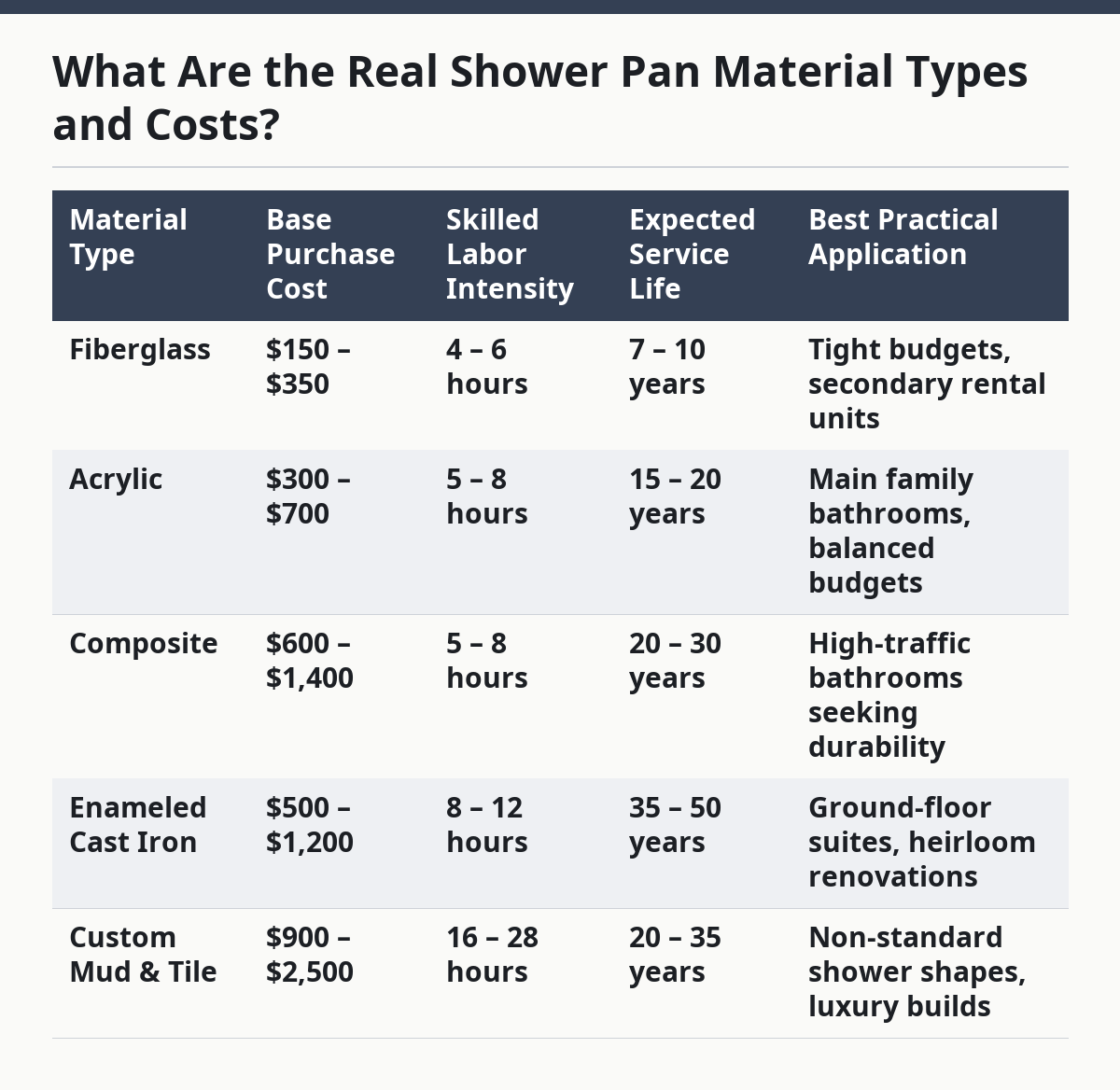
What Are the Real Shower Pan Material Types and Costs?
Shower pan materials dictate both the immediate purchase price and the structural labor required to set the basin correctly. Prefabricated units made of fiberglass or acrylic arrive ready to install, whereas custom mortar beds require on-site chemical mixing and extended curing schedules.
Fiberglass basins are the least expensive option, priced from $150 to $350 for the material. They consist of polyester resin sprayed over chopped glass fibers with a thin gelcoat finish. While inexpensive, fiberglass flexes under standard body weights, causing thin gelcoats to craze, discolor, and crack around the drain opening within 7 to 10 years.
Acrylic pans range from $300 to $700. Manufacturers thermoform a sheet of continuous cast acrylic over a mold, then back it with composite boards and fiberglass-resin blends. Acrylic resists impact, cleans without harsh solvents, and retains its finish for 15 to 20 years when seated over a bed of masonry mortar.
Composite and solid-surface pans cost between $600 and $1,400. Blended from mineral fillers and polymer resins, these models are rigid, heavy, and non-porous. They do not flex, require minimal sub-floor bedding, and can endure 25 to 30 years of daily use.
Cast iron pans topped with porcelain enamel cost between $500 and $1,200 for the unit alone. These pans weigh between 150 and 250 pounds, often requiring two or three workers to transport and maneuver into the alcove. The porcelain enamel finish is exceptionally scratch-resistant and lasts upwards of 40 years, though shipping fees and framing reinforcement add expense.
Custom tile bases cost between $900 and $2,500 in materials. That figure includes a pre-slope mud layer, a 40-mil chlorinated polyethylene (CPE) or polyvinyl chloride (PVC) sheet liner, a secondary mortar bed, liquid topical membranes, thin-set mortar, tile, and grout.
For a deeper comparison of finishes and installation methods, see the shower pan materials overview. The same page explains why one style costs more to install even when the pan itself is inexpensive.
| Material Type | Base Purchase Cost | Skilled Labor Intensity | Expected Service Life | Best Practical Application |
|---|---|---|---|---|
| Fiberglass | $150 – $350 | 4 – 6 hours | 7 – 10 years | Tight budgets, secondary rental units |
| Acrylic | $300 – $700 | 5 – 8 hours | 15 – 20 years | Main family bathrooms, balanced budgets |
| Composite | $600 – $1,400 | 5 – 8 hours | 20 – 30 years | High-traffic bathrooms seeking durability |
| Enameled Cast Iron | $500 – $1,200 | 8 – 12 hours | 35 – 50 years | Ground-floor suites, heirloom renovations |
| Custom Mud & Tile | $900 – $2,500 | 16 – 28 hours | 20 – 35 years | Non-standard shower shapes, luxury builds |
Labor Factors, Demolition Scope, and Plumbing Access
The demolition scope determines whether a shower pan replacement remains a contained repair or escalates into a major renovation. A shower pan cannot be pulled out like an appliance; its perimeter flange tucks behind the backer board and wall coverings.
Because of that overlap, contractors usually remove the lower portion of wall tile and backer board around the perimeter. Tile Council of North America guidance on shower receptors and waterproofing details supports this approach, since the flange must tie into a continuous wall assembly without punctures or gaps. If replacement tile cannot be matched to the existing wall, the scope can expand to retiling the entire shower enclosure, adding $1,500 to $3,500 to the project.
The practical result is easy to miss from the outside, but the framing below is what makes the repair work:
“`
+——————————————————–+
| Wall Studs |
| |
| [ Waterproof Membrane / Backer Board ] |
| | (Stops 1/4″ above pan floor, overlaps flange) |
| v |
| +—-+ <— Integrated Shower Pan Flange (Fastened) |
| | | |
| | +================================================ |
| | SHOWER PAN FLOOR |
| +——————————————————+
| [ Mortar Bed / Structural Support Foundation ] |
+——————————————————–+
| 3/4″ Subfloor or Concrete Slab |
+——————————————————–+
“`
Plumbing accessibility introduces another variable into labor pricing:
- Subfloors with crawlspace or open basement access: The plumber works underneath the shower to cut the old trap and attach the new drain assembly to the 2-inch DWV (drain-waste-vent) pipe. With this setup, plumbing labor is often limited to a short service call and can cost roughly $150 to $300.
- Concrete slab installations: The plumber must break out concrete around the drain with a rotary hammer or demolition breaker to reach the trap. A small pocket through the slab, trap reconnection, and concrete patch can add $400 to $900 in specialty labor.
- Misaligned drain rough-ins: If a replacement pan has a drain location offset by even 1.5 inches from the original pan, the drain line must be cut back and offset under the floor. Trenching, re-routing, and re-gluing the ABS or PVC pipe adds 2 to 4 hours of labor.
Subfloor inspection occurs as soon as the old pan clears the space. Leaking pans routinely drip water into structural components for months before homeowners notice surface stains. Replacing a rotted section of 3/4-inch exterior-grade plywood subfloor can add several hundred dollars to the job, and the total depends on the damaged area and how much finish work must be reopened. If structural water has softened the 2×10 floor joists beneath the shower, sistering new lumber alongside damaged wood runs $500 to $1,200 depending on accessibility and electrical runs.
For more detail on hidden framing issues, the subfloor repair resource shows where water damage usually starts and how contractors price the fix.
Should You Repair or Replace a Damaged Shower Pan?
Full replacement is necessary when a shower pan leaks through its base or suffers structural fractures, while surface repairs are suited only to shallow scratches or small chips. Homeowners often seek patch solutions to avoid tear-out costs, but patching a structurally compromised pan leads to internal wall rot and mold growth.
Surface refinishing and professional epoxy patching cost $200 to $600, depending on the extent of the blemish and the color-matching work required. That price can make sense for isolated cosmetic defects, but it does not restore a pan that has already failed at the drain, flange, or seam. The repair may look acceptable for a while, yet the underlying leak path remains.
Replacement becomes the better choice when the pan flexes underfoot, cracks keep returning, or moisture appears in the ceiling below the bathroom. In those cases, the problem is no longer cosmetic. It is structural, and the cost of delaying the work usually exceeds the cost of doing it once.
FAQ
How long does a shower pan replacement take?
Most straightforward replacements take one to two days. The job can take longer if the subfloor is damaged, the drain must move, or the shower needs new tile around the perimeter.
Can a shower pan be replaced without removing all the shower walls?
Sometimes, yes. If the existing wall tile matches and only the lower section needs opening, contractors may limit demolition to the bottom course or two. If the wall finish cannot be patched cleanly, more tile work is needed.
What makes a shower pan replacement more expensive?
The biggest price jump usually comes from slab access, hidden water damage, custom tile work, or a mismatched drain location. Those issues increase labor more than the pan itself does.
Is a fiberglass shower pan a good short-term option?
Yes, if the budget is tight and the shower gets moderate use. Fiberglass is the least expensive material, but it typically has the shortest service life.
When should I choose a custom tile base instead of a prefabricated pan?
Choose a custom tile base when the shower is not a standard size or when the design calls for a higher-end finish. It costs more, but it offers more layout flexibility.
Drafted with AI; not yet reviewed by a person.

One thought on “Shower Pan Replacement Cost: Pricing and Labor Guide”